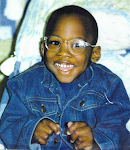
Wednesday, August 25, 2010

Dear students

I am aware that at least two of my friends and colleagues use my blog in their university courses. One teaches special education, and the other teaches human development. I may use it in my course this semester as well. If you are a pre-professional, post-secondary student who is reading this blog, even if only because your professor has told you to do so, welcome to my world.

In the past, I actually began my introduction on the first day of class with the phrase welcome to my world. I explained to my Introduction to Special Education students that the field composed a large part of my professional life, but also my personal life. I would tell the students that one of my goddaughters and a few family friends have cerebral palsy, and that a number of my friends and family have other special needs. Then I would tell them about my son, Sekai, a child for whom excerpts of his life story could be used as anecdotes in teaching all but 3 of the 18 chapters in our textbook. When I last taught this class, in the spring of 2009, my students learned a great deal about special education through my eyes as Sekai's mother, and through what he would tell me to tell them. The quote on the header for this blog is what he told me to tell them when he could not come to do his guest lecture after all because he was in the hospital. This fall, I will be teaching this course for the first time since his passing. Now there is one more chapter, "Transition and Adulthood", that I will not be illustrating through a story from Sekai's life. OK, yes, it is true that he had a transition plan in his IEP, but the truth is that he had a transition plan of his own, and will never make it to adulthood. I am grateful to have a guest lecturer for that content this semester. To say that I take this subject matter seriously is an understatement, but I am sure that by now you get my point. Now, let me leave you with a few more points.

First, please keep in mind that Sekai was first and foremost a child, just like the children that you will provide with education, special education or related services, medical care, child welfare services, or any other care for that matter, are children first and foremost. Being young human beings is not the same as being miniature adults, and there is little if any true power in their position. The challenges that many of these children face due to situational vulnerabilities are challenges that have been created by others and put on them, not challenges that they have created to put on you. Disability, especially when viewed through the lens of social construction, can also be considered situational, but this is not to grant you or anyone the license to assign blame or prescribe guilt to parents whose children have disabilities. If at any point you find yourself blaming a child for the challenging behavior that the child is presenting at the moment, please be cognizant and attuned enough to recognize that not only does that child need help (e.g., with expressing feelings, needs, or concerns; coping with intense feelings, needs, or concerns), but you may also need help in order to gain or regain the appropriate perspective. If at any point you find yourself blaming a child's parents, please reread the sentence above, replacing the word child with the word parent, and keep in mind that though parents are (often) adults, we may also need help. I would also like to add something that invokes glass houses or miles and shoes, but I think you get my point so I will leave that alone for now.

Secondly, please keep in mind that Sekai was also a spirit, as are the children whom you will one day serve. This is not the same as saying that he had spirit--and oh he did, let me tell you!--but rather I say this to make the point that some of his wisdom was beyond his years, and therefore difficult for some to comprehend. Are you familiar with the term old soul? It is a cultural reference, often used in the southeastern region of the U.S., and amongst persons of the African Diaspora. The term is used to describe a person, usually a child, who seems to have wisdom beyond that which could typically be obtained by a person who has been on Earth for however many years that child has been alive. Without delving into theology, let me simply quote Pierre Teilhard de Chardin to more fully illuminate this second point: "We are not human beings having a spiritual experience; we are spiritual beings having a human experience." To play with the semantics a bit, Sekai also had a spirit--which is still not the same as saying he had spirit, which he did, abundantly--as do the children that you will teach, a spirit that can be broken if mishandled. Please be mindful, then, that what you say and do to and about the children that are put in your care has the potential to either build them up in positive ways, or break their spirits in ways that you may not even realize. These ways may seem beyond your scope of concern if that child, like Sekai did, looks back at how you continued to live your seemingly happy-go-lucky life while he ruminated in whatever hurtful space was created by a negative word or misplaced term, the lack of concern only serving to reify and reaffirm the negative feelings. Please be mindful that certain words and actions are to the spirit what sticks and stones are to the body.

Lastly, please recall that Sekai had great spirit! Read the light points of the birthday memories post, or about his appreciation for chicken nuggets and reality tv for a glimpse of just how fun and funny he could be, this dear boy whose name means full of laughter. The children whose lives you will touch also have great spirit! I punctuated that sentence with an exclamation point because I want you to be excited about the possibilities! Each one of these young people who are presented to you for your support, assistance, encouragement, or who otherwise present you with an opportunity to fulfill your mission here and to contribute to the beauty of life on Earth has a personality, likes, dislikes, talents, gifts, hopes, and dreams. Each one of the children who are put in your path has the ability to introduce you to reasons to smile, and yes, perhaps reason to cry, but trust me when I say that no matter how physically, cognitively, or emotionally involved that child appears to be, no matter how distant or unconcerned that adolescent appears to be, that child, like Sekai, wants you to smile when you think of them, and when you interact with them. Each one, like Sekai, wants to know that you will remember them.

Have a wonderful semester. Be a wonderful student. Prepare to be a wonderful professional.

Feel free to post comments; in fact, please do post comments.

And remember Sekai.

Tuesday, July 13, 2010

Empty hand

I haven't posted in a while. Not that I haven't been writing. I have notes everywhere: in my phone, on the computer, on the backs of receipts, in various notebooks. I've been writing, or almost writing. Putting thoughts in words, but not refining. This I'm going to go ahead and write out, refined or not, just to get it out there.

Today is my birthday. Just like holidays are hard now, my birthday is very hard. I think my birthday is worse. When he came back, Sekai hated celebrating anybody's birthday. He said it reminded him that his birthday wasn't celebrated at the foster home when he was away.

I celebrated this weekend, and actually had a really good time. Then Monday, the tears came. The anger. The sadness. It wasn't until last night, well, this morning, a few minutes after midnight, when someone posted a birthday greeting to my Facebook page that it sort of clicked for me. It was officially my birthday. I had lived 13 months past my son in real time, and lived 22 years more in my life than he ever would in his life. And that hurt. Terribly.

This morning I was cheered up by the multitude of well-wishes through cards, Facebook messages, text messages, phone calls, and emails. My friends and family made a point to recognize me on this day, and the feeling was overwhelmingly warm. My mother even took the day off to be with me on my birthday. We planned to go to lunch. Then I suggested that we also try to see a movie. I had heard the new Karate Kid was supposed to be good.

[Spoiler alert] A few minutes into the film, I wanted to leave. The male child lead character in the movie is sad and fearful for much of the movie. This saddened me. He is beat up by other children, brutally beat up. This saddened me. The other children are encouraged to be brutal by their teacher, in what I could only process in my mind as child abuse: corrupting, embittering, taunting, even striking children for the purpose of making them fight each other. This saddened and angered me. Repeatedly, I wanted to leave the movie, but I didn't want to upset my mother who was doing all she could to make me happy on my birthday. And I wanted to see the movie turn around, to see the redemption. Before I could get to that place, the male lead character/positive male teacher is shown in a full on crisis of the heart. Before he even answered the question posed to him, I knew the answer. When he responded, "It is June 8", I almost screamed out loud. I wanted to leave. Right then. But I was afraid that if I stood up, the wails would also stand up, and that would be just too much for everyone. So I sat there. And waited for the redemption.

And for those of us who remember the original, or who have ever seen a "good versus evil" movie, we know the redemption comes in the end when the underdog triumphs. In Western culture, we seem to like stories of underdogs rising up and beating the meanies at their own games. My mind, though, kept going to Sekai. Sekai, who could out-talk and even out-whit his enemies, but could not physically escape them. I thought of the time a classmate yelled at him after the teacher moved Sekai in his wheelchair in front of the other student in line. The other student was physically imposing by grown man standards, and knowing he could not get away from him, Sekai began crying in the cafeteria, in front of everyone. When he came back home, Sekai was enrolled in a middle school in the new district; I was concerned, but he was happy, saying that he did not ever want to go to high school again. Sekai died the week before his second graduation from middle school, and I could not help but wonder if he had high school, among other things, on his mind.

Just as he could not escape the bully at school, or being promoted to high school, he also seemingly could not escape foster care, and the corrupted, embittered, taunting meanies and bullies there. Watching the teacher on the screen who taught his students to hurt others, I could not help but think of how we as parents put our trust into people and systems that are supposed to care for children, and how easily that trust can be broken. The students in the movie believed what their teacher was telling them, until they realized the losses they faced as a result. Sekai believed what his teachers, foster parents, social workers, judges, therapists, attorneys, and others were telling him, until he realized the losses he faced as a result. No kicks, blocks, or spins could help him. He didn't see himself as the underdog who would get redemption.

So he wanted to leave. Right then. And the wails stood up. And it was often just too much for everyone. And still I sit here. And wait for the redemption.


[PS-Karate is translated as "empty hand". Sigh.]
[PPS-I learned at a recent conference that bereavement, particularly loss of a child, forever changes one's perspective. I concur.]

Thursday, June 10, 2010

One

I can still hear it. It has been one year (how has it been one whole year?!) and I can still hear it.
Doctor: "Time of death, 7:19. We should get the family in here."
Nurse: "That's his mother right there."
Doctor: "How long has she been there?"
Nurse: "She's been there the whole time."
Doctor, to nurse: "Oh, no."
Doctor, to me: "We tried..."
Me: "Please, just try again. Just, try. Please, please, please try again..."
Doctor: "We did...We tried everything..."

Rest in peace, sweet child of mine. I love you always, Sekai Ayinde Williams. Love you. Always.

Sunday, May 9, 2010

Mother's Day musings

If receiving a child is a blessing, then is losing a child a curse? And to lose a child at his own hands?

I have purposely left the final edits of my dissertation for today. As I wrote in a previous post, completing my dissertation serves two purposes: 1) I am able to complete part of the task Sekai set for me; and, 2) I am provided with a much-needed distraction. In a conversation yesterday with someone who will be catching up on work today, I mentioned that I was going to ignore Mother's Day by working on my dissertation. She responded, "I can relate." I think I know what she meant, but I could not respond with what was running through my head. Can you relate? Isn't your son at university? Ignoring the day intentionally by scheduling work is not the same as having to forgo the day because of work. There were other thoughts, but I assured myself that she meant no harm, and probably was not even thinking about the situation in those terms. And why should she? It has occurred to me that bereavement is like race/ethnicity, gender, (dis)ability, and any of the life situations which lend themselves to alternative perspectives and critical theories in that way: if one does not have to think about it, then, generally, one does not.

Mother's Day of course presses the issue. I find myself not wanting to contact my friends who have children because I do not want to serve as that constant reminder that life, even a child's life, is entirely fragile, and that the the status of active motherhood (as in day-to-day parenting) can be fleeting. I am not spending it with my mother because years ago I decided that it was too hard for me to celebrate her without thinking of my own situation. Some may consider that selfish. I am sorry. It is the only way that I can think of to not make her feel bad and, yes, to not make myself feel worse. She is out of town today hearing President Obama deliver the commencement address at Hampton, and I am thrilled for her. She deserves a happy Mother's Day, even if I cannot provide her with one.

Only once have I had a Happy Mother's Day. As a mother, I mean. As a child, I would go all out with the homemade cards and breakfasts, and as a young adult, Mom and I would shop for her summer flowers on this second Sunday in May. As a mother, well, I have only once had that special warm and fuzzy feeling on this day. The first Mother's Day that Sekai was home, he was only 2 years old, and he was sick that day. Nobody called to wish me a happy Mother's Day, and the only card that I received was from myself. Not only was he not adopted at that point, he was not even officially placed in my home, so my guess is that most people simply did not think of me as a mother. The following year, Sekai was 3 years old, and had been home for almost a year. Sekai and I got dressed up, went to church with my mother, and the three of us went out for a brunch afterward. It was a lovely day. The following Mother's Day, I was fighting to get him back home. Every Mother's Day from that point forward, I have cried. Last year, he was back home, and still, I cried. By that point, Sekai had made it known that he intended to leave this earth, and he did everything he could to push me away in the hopes that that would stop me from trying to keep him alive. I went to brunch that morning with a foster/pre-adoptive mother who was introduced to me by the child psychologist who provided services to both of our sons. As we were leaving, she mentioned that Mother's Day was one of those holidays that she did not really acknowledge, and in so stating, made it clear to me what I was feeling was my feeling alone.

When I arrived back home, Sekai presented me with a homemade card that expressed his feelings towards me. Line after line after line extolled the positive aspects of my motherhood. And then he signed it with his legal name. By this point, his ability to catch me off guard, to cause me to feel the sudden, unexpected, and unrelenting pain that he had felt upon being snatched away from me by lying mouths and taunting hands as a toddler was ratcheted up to full throttle. I looked at him, and he was smiling. Then I said something about how he had hurt my feelings signing it that way. His face fell. His mentor from the therapy program explained that she had written it that way. I recalled that he had asked to sign a birthday card for a family member with his "family name" just a few weeks ago. In my mind now, I try to read the look that was on his face. Was it intentional? Or was he genuinely sad that he had hurt my feelings? Was he really trying to be kind and loving? Did she write his legal name without asking for his input? Did his face fall because she wrote it without asking for his input, thereby underscoring his point that because he had not been taught to read and write that he was at an incredible disadvantage? Had he meant to taunt me, but been surprised and then sorry at how much he had hurt me? Was his facial expression not indicative of anything other than grimaces and spasms secondary to his neurological condition?

This last query weighs on me. I have spent countless hours analyzing what did he mean when he said..., but what was he thinking when he made that face when... has a torturous nature of its own as I watch the faces of my goddaughter and another family friend, both of whom also have the diagnosis of cerebral palsy spastic quadriplegia, and I am reminded that facial grimacing can be one of the effects of this condition. Recently, I asked my goddaughter what she was thinking in a particular situation. We had been out at a restaurant having dinner with the family, and on our way out, she had to use her power wheelchair to navigate a walkway and ramp on which a number of people were standing. There was another young woman who was also using a wheelchair going down the ramp, and from her appearance, I am guessing that she may also have had the same condition. And then I saw my goddaughter make that face. The same one that I saw Sekai make often. I had an idea what she was thinking, but I didn't want to guess, and this was my opportunity to possibly gain some insight into what he may have been thinking, and also to be better able to understand what she was experiencing. So I asked her what she was thinking. She hmmm'd and ummmm'd, and then said she would tell me in a minute (once she got down the ramp). Her dad and brother laughed, and replied that we all knew what she was thinking. (Like Sekai, she has been referred to as, shall we say, sassy.) Once she was at the van, I asked her again. She made the face again. The young woman who was using the manual wheelchair was being lifted into that family's truck. I watched my goddaughter's eyes go over to them. She hmmmm'd again. I told her that I had an idea what she was thinking, but I wanted to be sure, and that I wanted to know because Sekai made the face so often and I wanted to be sure that I was not misinterpreting the spasms as actual facial expressions; I wanted to be sure I was interpreting it correctly. She sighed. Looked at the other family. Sighed. Made the face. Said "yeah", and drove into the van.

Sometimes, I hope that those faces are just spasms. My friend makes them, and I'm almost positive that they are just spasms, especially since I have seen him make them when we were all joking and laughing. Since that Mother's Day card was the last written sentiment that I have from my son, I hope that the facial expression was just a grimace. If he was crestfallen at my response, that means he actually was trying to show me love, without a dig at the end, and I missed it. I miss it now for sure.